Vendure as a Modern E-Commerce Alternative
Setting up a simple online store is a matter of minutes these days. Platforms like Shopify promise quick success: a few clicks, and your digital storefront is up and running. As long as you stick to the built-in features, it works great.

E-Commerce · 26.06.2026

However, the reality of modern e-commerce projects usually looks quite different. As soon as slightly more complex pricing logic is required or an existing ERP system needs to synchronize data, closed SaaS platforms reach their limits. You end up building fragile workarounds and struggling with API limits.
Vendure was developed precisely for these scenarios. As an open-source solution, it offers a framework that can be configured and extended right down to its core. But how does Vendure stack up in a direct comparison with established providers?
We take a technical look at Shopify, Shopware 6, Magento, and BigCommerce, and show why the right tech stack determines the scalability of your platform.
The Technological Playing Field
The architectures on the market differ fundamentally in their philosophy: While monolithic systems rigidly link the front end and back end, modern headless solutions separate them completely. Although cloud SaaS platforms offer a ready-made infrastructure, they lock developers into a technological black box.
The following overview provides a direct comparison of the technological components of the largest platforms with those of Vendure:
| System | Core Technologies | Architectural Style | API |
|---|---|---|---|
| Vendure | TypeScript, Node.js (NestJS) | Headless / API-first | GraphQL (native) |
| Shopify | Ruby (on Rails), Go (core components) | Cloud SaaS (Proprietary) | GraphQL & REST |
| Shopware 6 | PHP (Symfony), Vue.js (Admin) | Headless-capable / Monolithic Legacy | REST |
| Magento (Adobe Commerce) | PHP, Laminas (Zend), Knockout.js | Classic Monolith | REST & GraphQL |
| BigCommerce | PHP, Ruby, Java | Cloud-SaaS / API-driven | REST & GraphQL |
The JavaScript Advantage: Why TypeScript Speeds Up Development
Vendure’s biggest advantage lies in its foundation: TypeScript and Node.js, powered by the NestJS framework. While existing systems like Shopware or Magento have relied on PHP for years, Vendure uses the same language as the front end (whether React, Vue, or Svelte). This unified stack reduces friction when switching between the front end and back end. Developers work in a fully typed ecosystem, which reduces the error rate and significantly increases development speed.
In addition, Vendure benefits from Node.js’s asynchronous event loop. Compared to traditional PHP architectures, which must start a new process for each request, Vendure is extremely resource-efficient and inherently designed for high concurrency. This means higher throughput with lower server costs and noticeably better performance during peak loads.
Native GraphQL instead of retrofitted APIs
Many platforms have built GraphQL on top of existing REST APIs or relational database models as an afterthought, which is often evident in poor performance and complex queries. Vendure, on the other hand, was built around a native GraphQL schema from the very first line of code. Both the admin area and the shop API speak the same language. For developers, this means maximum efficiency.
The front end uses precise queries to retrieve exactly the data it needs for rendering (no over- or underfetching). Thanks to native integration, the API is not only fast but also end-to-end typed through the automatic generation of TypeScript types from the GraphQL schema. If a data field changes in the back end, the front-end build is immediately updated before the code even reaches production.
Batteries-Included Framework
Setting aside direct comparisons, Vendure is a modular, lightweight monolith that comes equipped with all the essential tools right out of the box and is extremely easy to extend. We’ll cover some of these features, which simplify complex requirements, in more detail in future blog posts:
Vendure supports multi-tenancy directly in the core. With channels, you can use a single Vendure instance for multiple stores, allowing you to have separate currencies, languages, and prices for each store.
Products and orders can be easily shared across channels or kept separate, making this ideal for B2B/B2C divisions or internationalization.
Vendure's built-in cron job infrastructure allows you to control recurring background processes directly through the Core. No external tools are required, which keeps the architecture lean.
This is ideal for regularly synchronizing inventory levels with the ERP or sending automated emails.
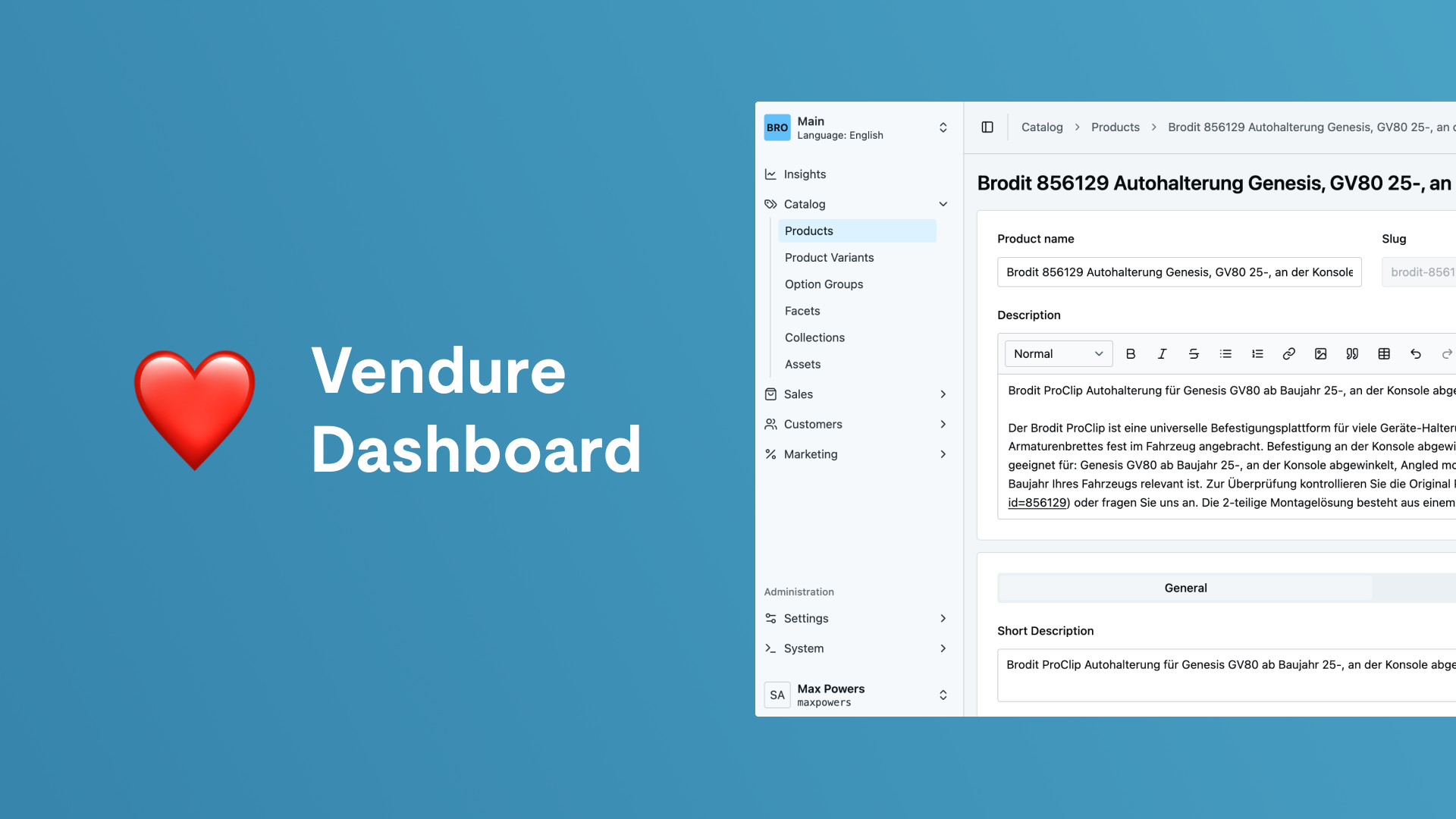
With the new React-based dashboard, customizing the admin UI is extremely easy. You can override standard inputs or add your own widgets entirely.
This way, the customer sees exactly the fields they need for their workflows in the backend, without having to rewrite half the UI.
Vendure's architecture is designed to be so flexible that even very specific pricing calculations can be integrated quite easily.
Custom B2B discounts, tiered pricing, or dynamic calculations can be implemented directly through the core, without having to overcomplicate the system with countless plugins.
Because Vendure is built on GraphQL, it's extremely easy to extend the API using your own resolvers.
You can add API-specific fields or calculations without having to modify the underlying data model in the database.
Pretty cool, isn't it?
We’ve already implemented many e-commerce projects with Vendure, both large and small! With our expertise and as official Vendure partners, we know how to perfectly tailor the system to individual processes, rather than forcing the processes to fit the system.