B2B-Shops with Vendure
A B2B shop is not a B2C shop with a login. Anyone who wants to handle customer-specific prices, company accounts and an ERP properly in their shop quickly discovers where many systems reach their limits. Here we explain why we at Neovo rely on Vendure for B2B and what it delivers in real projects.

E-Commerce · 12.11.2026
Sound familiar?
The shop works. Sort of. But customer prices are updated every night via an Excel import. Key accounts still prefer to order by email because their buyer sees the wrong prices in the shop. And every small change to the checkout turns into a project of its own.
In almost every first meeting with B2B companies, we hear some version of this story. The problem is rarely the shop itself. The problem is that the system was originally built for consumers, and B2B was added later.
In this post, we explain why we at Neovo rely on Vendure for B2B: what really matters in a B2B shop system based on our experience, what Vendure does differently and what this looks like in real projects.
What a B2B shop needs to do
In B2C, a person buys a product at list price and pays by card. In B2B, the same purchase looks very different:
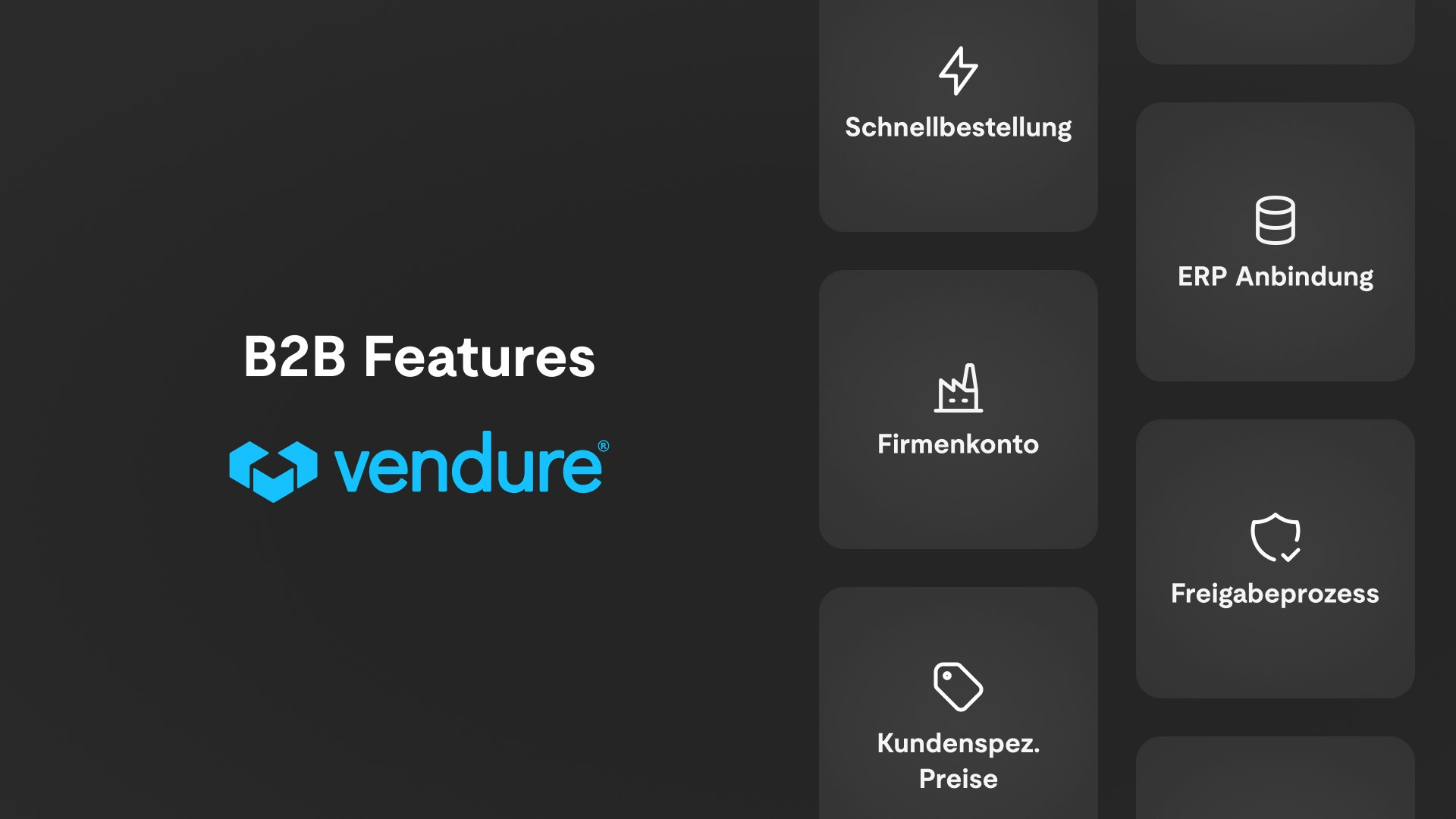
Customer-specific prices: Every customer has their own terms, tiered prices and discounts, usually maintained in the ERP.
Company accounts with roles: Several people order on behalf of one customer. One may place orders, another has to approve them, a third only wants to see invoices.
Approval workflows and limits: Orders above a certain amount first go to a responsible person.
Ordering on invoice: 30-day payment terms instead of a credit card.
Quick order: Buyers know their item numbers. They want to paste a list and be done, not click through categories.
ERP integration: Prices, stock levels and orders must stay reliably in sync with the ERP.
None of these points is exotic. And yet this is exactly where many shop projects fail.
What about Shopify, Shopware or Magento?
First things first: these are all good systems. The question is not whether they are good, but whether they fit your business and your processes.
SaaS platforms like Shopify get you online very quickly and are strong as long as you stay within the standard. Systems like Shopware or Magento offer many features and a large range of plugins. In both worlds, however, we often see the same thing: as soon as a B2B process deviates from the standard, the search for the right plugin or the next workaround begins. And with each one, the shop becomes a little harder to maintain.
That is why in B2B the licence price is rarely the deciding factor. What matters is how well your processes can be mapped and how much effort the shop causes over the years. If you want to take a closer look at the technical side: our developer Manuel Oesch has compared the architectures here.
Why we at Neovo work with Vendure
Vendure is a commerce platform from Vienna, built with TypeScript and designed as a headless system from day one. From a business perspective, four points are decisive for us.
1. Open and extensible down to the last detail
The core of Vendure, the Vendure Framework, is open source. Typical B2B features such as company accounts, quick order, contract prices or approvals come with Vendure's commercial plans. The exciting part: even with a plan, the system stays open. Everything can be extended and tailored precisely to your business. So you are not buying a closed product, but a solid foundation that we build on.
2. The shop adapts to your processes, not the other way around
No two B2B businesses are the same. One customer needs a project number on every order, another an approval rule per cost centre, a third pipes cut to length. With Vendure, we implement this directly in code, cleanly and update-safe, instead of with workarounds around a closed platform.
3. The ERP remains the data master
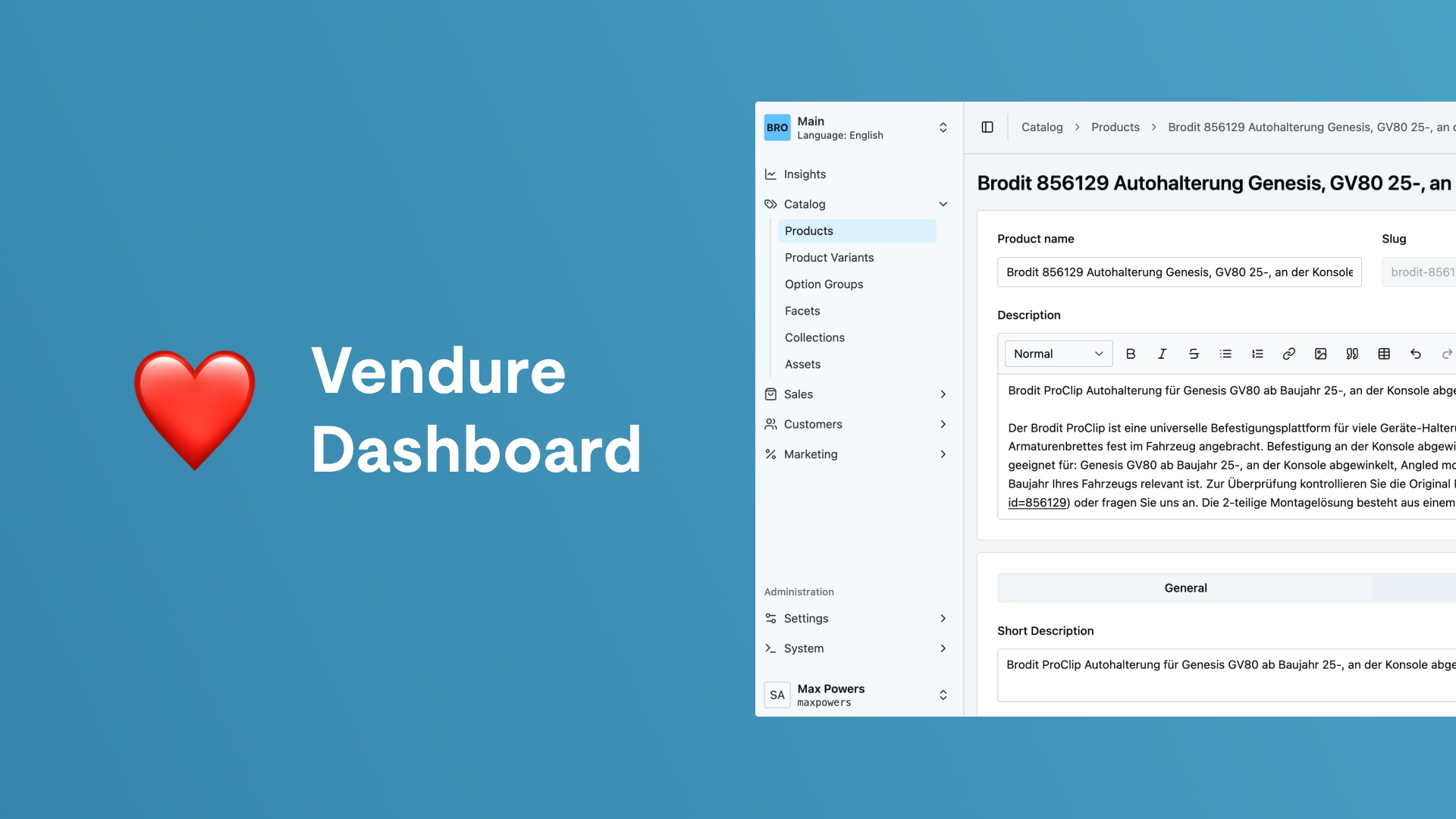
In most B2B companies, the ERP owns the data on items, prices, customers and orders. Vendure does not change that. The shop is connected via a modern GraphQL interface and takes its data from the ERP. For everything that cannot reasonably be kept in the ERP, such as detailed product descriptions or additional attributes for marketplaces, the Vendure Dashboard can easily be extended with PIM functionality. Jürg Hunziker shows how flexible the dashboard is in his post on the Vendure Dashboard.
4. Multiple shops and channels on one platform (multi-tenancy)
B2B and B2C, several brands or countries: with Vendure they all run on the same platform, each with its own catalogue, prices and rules per shop. You maintain the data and interfaces only once.
From practice
CarCom electronics AG: two shops, one backend, many marketplaces
For CarCom electronics AG, we rebuilt brodit-shop.ch and the CarCom shop from a technical standpoint. Both shops run on a shared Vendure platform and differ only in their product range and look. Additional shops can be added with little effort.
The Comatic ERP remains the leading system: products and customer data are synchronised, and orders flow automatically into the ERP, including invoicing. On top of that come customer-specific discounts and transparent clearance pricing. Because the products are also listed on Digitec Galaxus, Brack, MediaMarkt and TCS, we extended Vendure with PIM functionality. This means there is no need for a separate PIM and its licence costs.
HANS KOHLER AG: steel trading
A project that is particularly close to my heart: I had the privilege of guiding the platform of HANS KOHLER AG, one of Switzerland's leading stainless steel suppliers, as Product Owner at the time.
Before, orders came in by phone, email and fax. Prices are customer-specific, pipes are cut to length and everything has to work together with the Microsoft ERP. With Vendure at its core, a platform for B2B and B2C customers was created, including a cutting feature.
What both projects have in common: the team could focus on customers' needs instead of fighting the system.
Why we enjoy doing this with you
We made a conscious decision for Vendure and rely on it entirely for e-commerce. That means we know the system inside out, from the architecture and extensions to day-to-day operations. As an official Vendure partner, we also have a direct line to the team in Vienna.
Switching shop systems is not a small step, we know that from our own experience. That is why we first look at your processes and systems together and then plan the path that suits you.
Ready for a chat?
Are you unhappy with your current shop or about to choose a new system? Tell us about it, with no strings attached. We look forward to a coffee and your questions. You can contact us here.